Safety just had its cell-phone moment.
Reaching help used to mean getting to the infrastructure: the wired phone, the corner call box, the panic button bolted to one wall. Then the network moved into the air, and the phone became whatever you already carried. School and community safety is making that exact jump now. Here's the whole shift: what changed, what we built, and why it can't be un-rung.
"A panic button creates panic. A Flare ends it."
Generation 2 is in the field. Running in 911 centers, sheriff's offices, and school districts across multiple states, built on MyFlare Alert, Sentinel, SightDesk & Command Center, with T-Mobile for Government & INTRUSION.
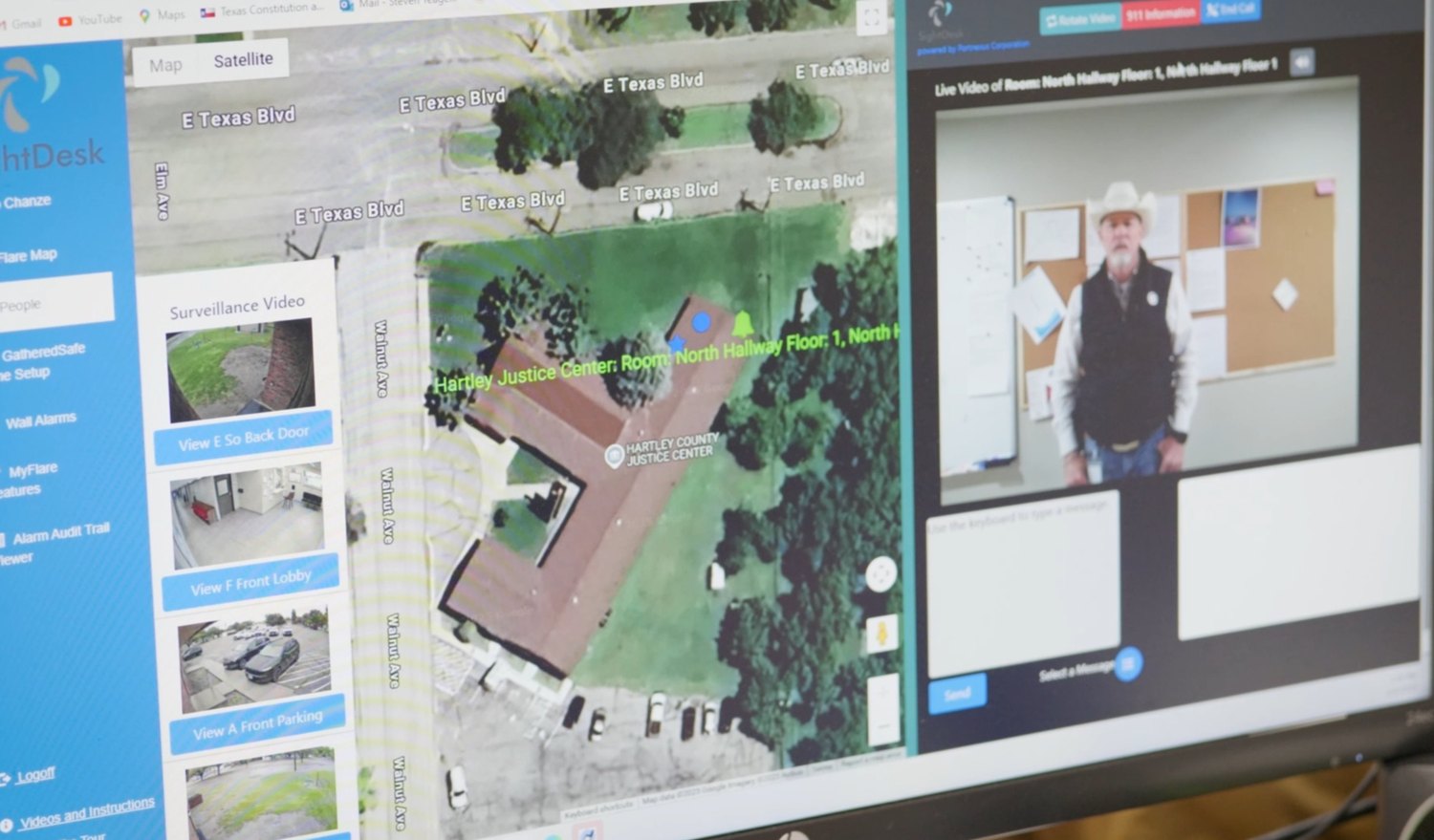
Chaos lives in the dark for only the first five seconds.
A Gen 1 alert produces panic by structure. A badge press says something is wrong, but nothing about what, where, or whether it's real. So every alert triggers the same building-wide response, because the architecture can't tell an active threat from a medical call from an accidental press. Everyone responds as if it's the worst case, because no one yet knows.
Gen 2 ends the unknowing in seconds. Then you see. Then you hear. Then you know, and you decide what happens next.
Personnel don't have to think. They act from training, because the training was built for this exact moment. False alarms stand down before they ever trigger a building-wide response. Real events trigger the right one. Clarity is restored.
Gen 2 became possible because the infrastructure shifted. It became necessary because the funding did too.
The network reached the edge
Reusable rockets put satellite connectivity into orbit at consumer scale. 5G arrived with reliability that didn't exist in 2018. The terrestrial-plus-satellite stack is now everywhere.
The grant era is tightening
Gen 1 was funded by grants, bonds, and mandates, and many never qualified: parochial, charter, rural, tribal, bond-failure districts. The capital is drying up exactly as the need grows.
The endpoints are already there
IP cameras, smart boards, classroom phones, staff laptops, the phone in every pocket, already installed, already paid for. Gen 2 was built to use them.
Eight years ago we were inside LoRaWAN, a provisional patent on a LoRaWAN safety architecture, Sprint as our commercial partner. Then T-Mobile acquired Sprint, the disruption forced a pause, and COVID extended it. In that pause, we looked up, saw what was coming, and walked away from our own product. We kept the response-chain architecture and rebuilt it on the infrastructure that was about to arrive.
Three companies. One Gen 2.
Gen 2 isn't one product, it's three layers, from three companies that each walked away from old infrastructure to build it. PortNexus left LoRaWAN behind for the response system. INTRUSION left hardware behind for a zero-trust SaaS. And T-Mobile put cell towers in space. Together, they turn a place into a protected zone.
Connects it.
Cell towers in space feed the zone from above, and stay overhead when the ground network fails. The mesh isn't on the ground anymore; it's in the sky. Ubiquity, plus a path that survives when the wires are cut.
Secures it.
Zero-trust enforcement jacks into every endpoint, and the privacy lock keeps cameras and mics dark until an authorized role fires a Flare. That's what makes the new endpoint surface safe to authorize.
Delivers it.
The Flare, the role-based routing, the live dispatch picture, the response chain. The system that turns a connected, secured zone into safety.
T-Mobile connects it. INTRUSION secures it. MyFlare delivers it.
Gen 1 was tied to a device. Gen 2 is tied to roles and rules.
A teacher on a smart board, an SRO on a phone, an administrator on a laptop, a visitor on a wearable badge, all produce the same Flare, route through the same rules, reach the same command surface. Gen 1 needed the right person holding the right device at the right moment. Gen 2 removes that dependency: the activation follows the role and the rule, not the device.
The board on the wall becomes the witness
As states restrict student devices in class, the in-room safety endpoint disappears. Gen 2 answers with the interactive smart board, on the wall in roughly nine of ten U.S. K-12 schools. On activation, its camera and mic become eyes and ears inside the five-second window.
It never watches until it's allowed to
INTRUSION Shield holds a camera-privacy lock the rest of the time. The board does not watch the classroom until an authorized role activates it under a defined rule. Awareness on demand, not surveillance.
Govern what's already there
The endpoints that deliver clarity in the first five seconds are already in the rooms where children and staff spend their day. Nothing new needs to be built. Everything new needs to be governed.
What changed, line by line.
Authorizing a room to see and hear is only safe if no one outside the rules can reach it.
That's a cybersecurity problem, not a safety-tech problem, and it's the one INTRUSION exists to solve. We came from the response side: panic-button limits, dispatch latency, classroom awareness gaps. INTRUSION came from threat intelligence: TraceCop's catalog of more than 8.5 billion IP addresses, bidirectional zero-trust, and the discipline that hardens endpoints against the very intrusion their name describes.
Endpoint, on-prem, and cloud
Shield Endpoint and Shield OnPremise attach to MyFlare deployments; Shield Stratus extends the same packet-filtering to the cloud command surfaces dispatch relies on.
Cameras can't be hijacked
The endpoint surface that makes Gen 2 powerful is the same surface that must be defended. Shield makes it safe to authorize, so the awareness can't be reached, redirected, or impersonated.
Two companies, both having walked away from 2018-era assumptions, arrived at compatible architectures. MyFlare sparks Gen 2. INTRUSION ignites it, because Gen 2 can't exist without a cyber layer that makes the new endpoint surface safe to authorize.
It doesn't just grow. It reasons.
A fixed system does what it was wired to do the day it went in, and nothing more, ever. A network grows, and gets smarter. Every device that joins becomes a new capability, governed by the same rules.
And because every node reports its own condition, the response adapts to reality, not an assumption. An officer working a dead zone still reaches SightDesk over satellite, and SightDesk, seeing the link is thin, doesn't wait for a picture that isn't coming. It routes the nearest responders to back them up. Intelligence a fixed device will never have.
One anchor opens a community, and no one can invite themselves.
Before any institution joins a GatheredSafeZone, the law enforcement agency for that jurisdiction nominates and invites it. The architecture spreads only through LE-authorized invitation, unauthorized entities can't buy their way in. The sheriff controls who is in; the architecture controls what they can do.
A county unlocks at once
One county-level authorization makes every institution inside reachable on the same response chain, schools, government, faith-based, EMA, under the same rules and the same Shield.
Institutions bring their peers
A school brings in the church next door. A deputy-level entry spreads through the institutional network without waiting on a sheriff. The architecture has gravity.
Sheriffs refer sheriffs
One county refers the next across the line, and a new cluster opens, sheriff's office, schools, higher ed, EMA. Spread doesn't require the sheriff; it requires authorization.
Who you are, what you are, where you are, coordinated.
Old systems knew one thing about you: which building you were in. Gen 2 coordinates three. A person and a device each carry a role. A place carries its own rules and actions. And because your license travels with you, your safety moves through the world with you, handing off from zone to zone as you go.
Roles, carried by your license
A person has a role. A device has a role. Your MyFlare license carries who and what you are into every zone you enter, issued once, recognized everywhere.
Zones with rules and actions
A place isn't a dot on a map. Each zone, a school, a church, a hospital, carries its own rules, its own response, and its own broadcasts.
The zone you're in governs
Cross from one zone to the next and your safety and communications hand off automatically. You're always under the rules of the ground you're standing on.
A tornado touches down, and everyone standing in the zone gets the warning, member or stranger, because the alert follows the ground, not the org chart. That's the ubiquity of the mesh: one license, issued by one organization, is your key to all of it, your personal safety folding into every community's safety net the moment you step inside.
Protected the whole time, not just at the press.
Gen 1 shows up for a moment. Gen 2 is there before, during, and after the event.
Tested every month
The response chain is codified, validated, certified, then tested monthly. Failed devices are decertified and recertified on fix. The school can prove readiness any day of the year. Not a binder on a shelf.
No crying wolf
Dispatch sees and hears in five seconds. False alarms and accidental presses stand down before they cascade. No false 911, no needless lockdowns, so staff and community keep trusting the system.
The institution owns it
A time-stamped, multi-modal trail compiles to an AAR in the school's own storage, to defend before parents, boards, insurers, and auditors. Clery compliance as a byproduct. Untouched by PortNexus.
The category began to ignite in 2025, and caught fire in 2026.
This isn't a startup finding traction, it's a fourteen-year-old architecture. We launched it in 2012 as Pledge, for distracted-driving and lone-worker safety, and it has run at scale ever since: the largest field-service company in the U.S., one of the largest cross-border railroads in North America, and one of the country's largest alcoholic-beverage distributors, millions of transactions a year.
The same architecture runs the other end of the scale just as well: a single school, a rural sheriff's office, a county of a few thousand. Biggest fleets in the country to the smallest town on the map, one platform. MyFlare Alert is that architecture turned toward schools and the officers who protect them: operational in Falmouth, Maine in 2023 with Chief Kilbride, first school-safety revenue in 2025. It is in the field now: 911 centers, sheriff's offices, and school districts across multiple states.
Today a person sends the Flare. Tomorrow the room can too.
The architecture isn't finished, it's a foundation. Because the response already follows roles and rules instead of wires, every advance in detection, in devices, in intelligence simply snaps in. Here's the direction.
The board hears the shot
The same smartboard that becomes eyes and ears on activation can learn to recognize a gunshot itself, and fire the Flare to dispatch before anyone reaches for a button.
A human still decides what's real
Detection is never a verdict. A person confirms real-or-false on far more than sound, the live picture, the context, the rules, so the system reasons, but never acts alone.
Every node does its part
Every device, every person, every action carries its own rule. One event triggers a hundred precise reactions at once, each one exactly what that role calls for.
The truth follows who you are, not just where you are. You don't get the alarm for your building, you get the response for your role, and you see, and act on, what's real.
A panic button creates panic. A Flare ends it.
One stops at the press. The other replaces chaos with clarity before panic has time to take hold, then runs the response that was planned, drilled, and locked before anything ever happened. See which door is yours.
No cost to evaluate · Law enforcement seats are always free · We respond within 24 hours
MyFlare Alert sparks the second generation of school and community safety, with ubiquity.