
The bus becomes a room.
The room just happens to move.
Every protected classroom on the MyFlare network has a Sentinel. Now every bus does too. A Sentinel tablet mounts above the driver, and one press puts the bus on the 911 center, school dispatch, emergency management, and the closest responder screens, all at the same second.
The coordination layer for the first minute of any emergency now rides the route, with cellular and satellite connectivity built in.
The one classroom that leaves the property every day.
A driver in trouble today
A driver with MyFlare
One press. Hands stay on the wheel. The Sentinel above the driver fires the Flare, and every screen that matters lights up with the bus in motion, its exact position, speed, heading, and rider count, plus live audio and video from the cabin. Nobody dials. Nobody describes. Nobody relays.
One tablet. One press. Every screen that matters.
The Sentinel tablet works exactly like the Sentinel on a classroom Smart Board. Same activation, same confirmation, same connection to dispatch. The difference is that this room moves.

This is how it looks from the driver's seat.
A hardened tablet, mounted above the driver, right on the sight line where every driver already checks the cabin. It displays the live view, confirms the Flare when it fires, and carries two way communication with dispatch.
No wiring through the district's network, no new console to learn. The Sentinel arrives configured, mounts in the cab, and the bus joins the same network protecting the classrooms it drives to.
● Smart Panic Button
One press fires a Flare through the Sentinel. No dialing, no reaching for a phone, no describing a location while driving. The same trigger and confirm sequence a teacher uses in a classroom today.
● Smartwatch
A wrist based trigger. Tap to Flare, even if the driver cannot reach the button. Because a hand on the wheel should never be the reason help starts late.
Two emergencies. Two response orders. One press.
An armed threat and a medical event trigger completely different response cascades. Choose one, press the button, and watch who responds, in what order, on one shared screen.
What the 911 center sees the moment the driver presses.
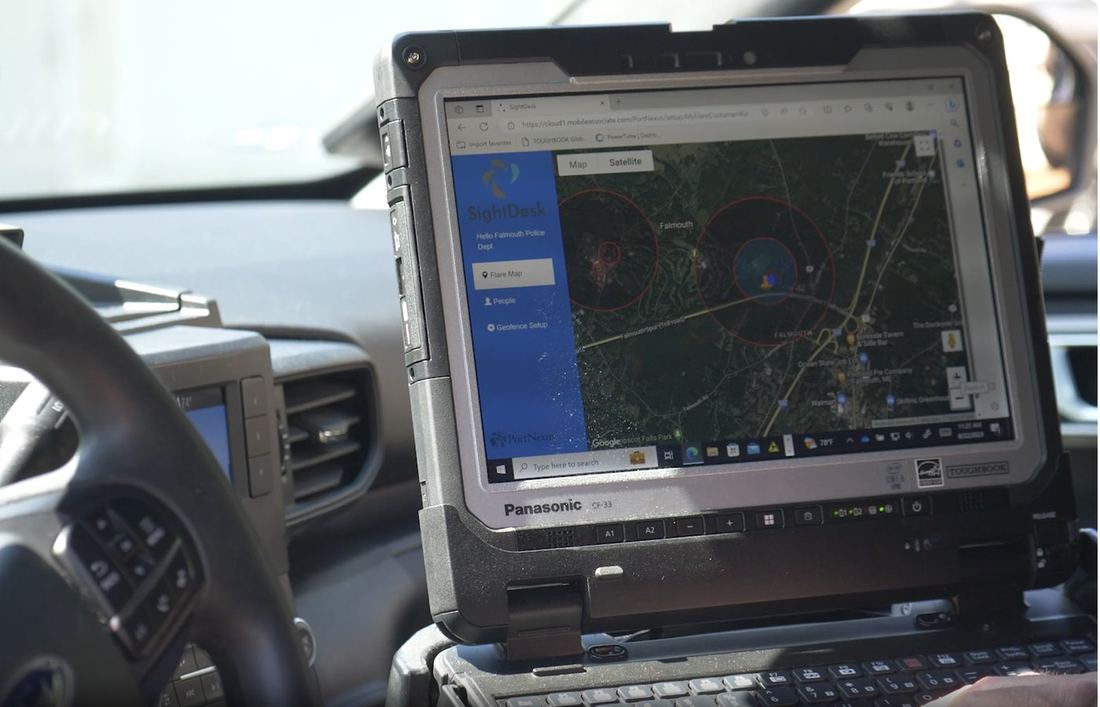
This is SightDesk, the console the 911 center, school dispatch, and emergency management share. One press on the bus and this screen appears.

Location truth, in motion
Not an address, not a description over a radio. The bus, its speed, its heading, and its rider count, live on the map as it moves. Dispatch never has to ask where the bus is.
A live channel to the cabin
Two way communication the moment the Flare fires: text, verbal, and pre set hot buttons. The dispatcher and the driver share one picture instead of trading descriptions.
Eyes on the incident
Audio and video from the Sentinel above the driver, with every action logged to the audit trail from the first second.
Dispatch shares. It does not relay.
The route does not end at the county line.
A MyFlare license travels. Every authorized GatheredSafeZone on the network recognizes the bus and its riders, so protection does not stop where the map changes color.
▸ The away game
Friday night, ninety minutes from home. The bus is still one press from the local 911 center it is driving toward.
▸ The field trip
A museum three counties over. Same Sentinel, same press, same shared screen, in a jurisdiction the driver has never met.
▸ The band trip
Across the state line for the weekend. The network travels with the bus, because the network is the license, not the building.
The largest transit system in America rides unprotected.
What fleet directors ask us first.
What happens in dead zones?
Connectivity rides cellular networks with satellite connectivity for routes beyond cell coverage. The rural route is the reason the system was built this way.
How much training do drivers need?
The activation is one press, the same trigger and confirm sequence a teacher uses in a classroom. The Sentinel arrives configured, and driver orientation is a single session, not a curriculum.
What about student privacy?
Audio and video go live when a Flare fires, to authorized responder consoles. Every access is logged to an audit trail stored in your own repository, so the district holds its own record.
Do we replace our existing bus cameras?
No. The Sentinel carries its own live audio and video for the emergency channel. Existing camera systems stay right where they are.
What does our 911 center need to buy?
Nothing. Law enforcement and 911 center seats are always free. SightDesk runs in a browser, on the consoles and in-vehicle computers they already have.
The school bus solution deploys with the same Sentinel platform protecting classrooms, dispatch centers, and communities today. No cost to evaluate. Law enforcement seats are always free.