The first minutes are yours to answer for. Make them yours to command.
When seconds decide everything, the failure is always the same — no one knows the truth, no one's in command, and the minutes bleed out. MyFlare closes that gap before it opens: one network across your whole county — schools, churches, soft targets, and your own deputies wherever they are — running every day, not waiting for the worst one. When it comes, your people move on the plan you authored, under your command, with a record that builds itself. For your office, it costs nothing.
Already on first responders' phones. Running in 911 centers, sheriff's offices, and school districts — built on MyFlare Alert, Sentinel, SightDesk & Command Center, with T-Mobile for Government & INTRUSION.
Student phones are leaving the classroom for focus. Walk through what happens now when something goes wrong.
Good for focus. But it sharpens an old problem: when something goes wrong, calling for help still means someone dialing 911 — and a student without a phone has to find an adult first. Here’s how the next sixty seconds go today.
A teacher has an emergency — or, God forbid, a student. How do they reach you?
Even with a phone in hand, it’s a 911 call — seconds to dial, more to be answered, minutes to explain. A student, no phone now, has to find an adult first. And the first call you actually get is a parent in the parking lot.
What’s actually happening — what, where, how bad?
A shaking voice and “somewhere in the building.” You sort out the room, the threat, and the severity on the way in.
When does dispatch decide it’s real — and how?
On a phone call. Secondhand. No eyes and no ears on the scene — minutes of doubt before anyone can commit.
Who manages it — and how do you keep chaos from setting in?
Everyone calling everyone. No shared picture. Agencies arriving into the same confusion the teacher started in.
For the first few minutes, every one of those answers lives in the dark.
Now change one thing. Then you see. Then you hear. Then you know.
Same morning, same teacher, same emergency. The only difference: the plan was already built — so the first minutes run on rails, not nerves.
They reach you the instant it happens — no dialing.
The teacher fires a Flare with one button on the phone in their hand, or a tap on their watch — and it’s at dispatch before a 911 call would have connected. No dialing, no explaining. And where a phone isn’t the tool — a student, a substitute, a locked-down room — the same Flare is on the wall, the smartboard, a staff badge. Straight to dispatch, every time.
You see it — exact room, live, with severity.
Not “somewhere in the building.” The exact door, live audio and video, and how bad it is — the picture, before your first unit is on scene.
Dispatch calls it in four seconds.
The picture lands at dispatch — location, then audio, then video. One question, one button: real or false. Two automatic stages, one human call in the middle. A false alarm stops right there and never reaches you.
The plan manages it. You command it.
The instant it’s confirmed, the plan you authored fires on its own — every responder notified exactly as you set it. Nobody improvises, so chaos never gets its five seconds. And if it grows past the room, it hands clean to the EMC.
Planning removes the confusion — everyone acts to the training, not their nerves. Gen 2 removes the wasted time to truth. In seconds, silence ends and command begins.
A panic button creates panic. A Flare ends it.
A badge alert, a mass-notification system, a safety app — keep them. But they all do one thing: tell you something might be happening, then hand it to you. That’s the alerting cycle, and it fails the same three ways:
- Loud alarms that create confusion and unintended escalation.
- Broad notifications that spread before the facts are known.
- Unverified alerts that leave you asking: is it real, where is it, who acts?
MyFlare is the response cycle. It verifies first — a false alarm stops at dispatch — then runs the plan you built, on your policy, not a vendor’s defaults. We don’t replace what your schools chose; we’re the verified response layer on your side.
Every answer here comes down to one thing: the deputy who walks in knowing.
Not a radio call and a guess at the door — the exact room, live eyes inside, the plan already drilled. That's the line between sending your people in blind and sending them in ready. It's the part of the job you carry home — and the reason the rest of this matters: so they come home.
It's working every day — and most of the time, you never hear about it.
This isn't a button that sits dark until the worst day. It's running every day in the schools you protect, routing by severity — the routine never touches dispatch, the judgment calls get worked by the people on scene, and only the real thing reaches you. Roughly 8 in 10 incidents never need to leave the building. By the time a Flare lands on your desk, it's already real — and already moving.
Handled in the building
the everyday stuff
- Broken arm
- Fight
- Medical
- Behavior
- Locked-in locker
Routes to the nurse, admin, or on-site SRO. Logged for the after-action — but it never touches dispatch, and it never reaches you.
✕ Never reaches dispatchMediated escalation
the judgment calls
- Is it a weapon?
- Does this leave campus?
- Do we need EMS?
Someone on scene assesses it and decides — handle it there, or transfer to SightDesk at your dispatch and fire the Flare. A person makes the call, not a sensor's guess.
⤴ Reaches you only when a person says soLethal, unambiguous
the one you authored the plan for
- Lethal, unambiguous threat
Goes directly to dispatch and every authorized responder — no deliberation, no delay. The moment it's confirmed, the plan you wrote is already executing and the whole county is in.
⚡ Reaches you instantly · in motionA panic button has two states — off, and catastrophic. Everything in between is the noise that trains people to hesitate. MyFlare routes by severity, so false alarms never reach your desk — and when the real one does, it's already real, and the plan is already moving.
Not one screen everyone crowds around. One live picture — on every screen that matters.
The day it's real, the danger isn't only the threat — it's everyone working off a different scrap of truth. Here there's one network, not three systems that don't talk: the same live picture reaches every node at once, and each one acts on it.
Everyone sees the same thing — at once
Location, live video, who and what — on the deputy's phone, the patrol-car screen, the dispatch console, the situation room, the computers in the fire engine and the ambulance. Nobody waits to be told what they're walking into.
No single point to bottleneck
No one commander funnels the whole thing. Each agency acts in its own lane off the shared picture, and the plan you authored runs across every node at once — including your own deputies, wherever they are, on or off a configured zone.
They move together — without a huddle
Because they share the truth and own their lanes, fire stages, EMS routes, and deputies converge in concert as it unfolds — coordinated in real time, not relayed by voice one call at a time.
One event. One picture. Every screen that matters — updating as it moves.
A sheriff is already running exactly this.
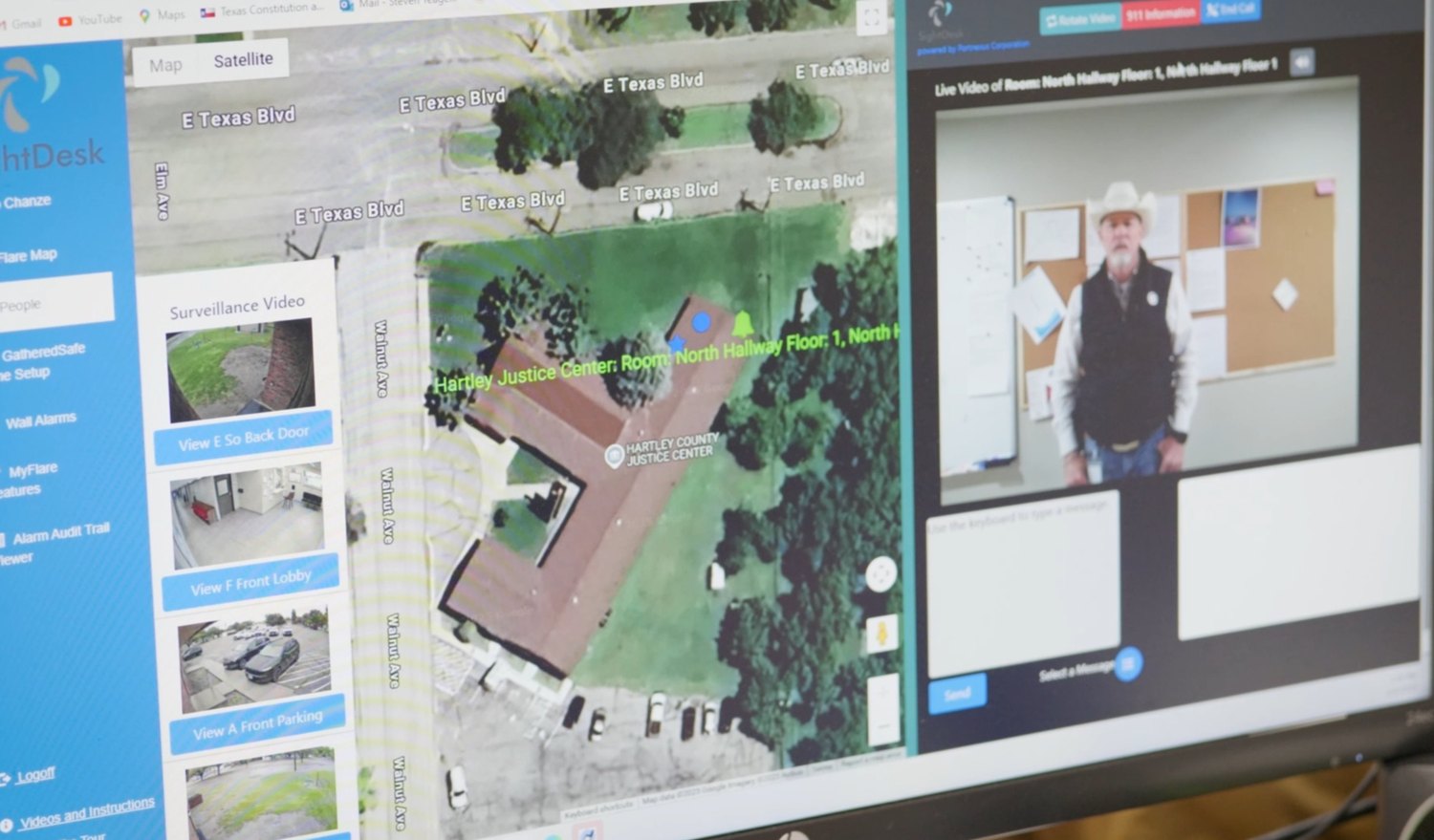
In Hartley County, Texas, Sheriff Chanze Fowler runs the most complete deployment in the network — eight surfaces across the whole county: his office, dispatch, the courthouse, county buildings, Channing School and its buses, judicial chambers and transit. He was live before Channing School ever came online. Next door in Dallam County, Sheriff Shane Stevenson and EMC Scott White run it too — two counties that share a jail, on one network across the line.
Chief Deputy Steve Yeager, Hartley County Sheriff’s Office. Not a script, and not us — the number two of the county running the most complete MyFlare deployment in the network, telling you what it’s actually like.
"If I own the plan, do I own the failure?" It's the other way around.
It's the worry sheriffs say out loud, so let's answer it. Every part of the response is built, drilled, and certified before it's ever needed — each side owning its own — so the day it's real, you can prove you planned it, not invented it.
The school builds theirs. You build yours.
The school tabletops its own zone — what happens inside, who's notified, how it's managed. You tabletop your response with your team. Each side owns its lane, in ICS format, and drills and improves it on its own schedule — nobody authoring anyone else's plan.
Both sides converge, certify — and it never goes stale.
You connect the lanes and run it live in test mode, responders suppressed, until everyone is certified. Then the system silently tests every endpoint each month — anything that has drifted is flagged and fixed before recertification. Nothing operates outside the cycle, and the gap always lands on the node that let it lapse, on the record.
When it's real, the plan runs itself — you don't invent it.
From the gate or a deputy's switch, the plan you authored fires exactly as written. No improvising under stress, no reaching for a binder. The worst minute runs on the work you already did.
And the record proves you did it right.
An audit trail and an after-action build themselves at event close — who knew what, when, who moved, timestamped — proving you planned it, it ran as written, and nothing was improvised. Written to your storage, never a vendor's server.
Strip it back and it's the two enemies of the first minute — confusion and wasted time. Planning removes the confusion. Gen 2 technology removes the wasted time to truth. So when it's real, nobody invents anything: everyone acts to the training they already did, the plan runs as expected, and the record proves it.
What does it cost, and what does it break? Nothing, and nothing.
Two answers most public-safety tools can't give you cleanly — so let's lead with them.
Every deputy, every seat — no per-seat fee, no trial clock. Law enforcement access is always no-cost, so putting your people on it never becomes a budget line you have to defend.
It runs on what you already have.
MyFlare is a coordination layer that sits above your systems — it doesn't ask you to tear anything out.
Works with your 911 center
The Flare and live feed surface at SightDesk alongside your existing CAD and dispatch — adding to them, not replacing them.
Your radios still run the call
Location, live video, and a covert channel layer on top of the comms you already use. No one is asked to give up the radio.
Onto the phones your deputies carry
Awareness reaches your people where they are — in their hand — so the responding unit isn't waiting on a relay to know what it's walking into.
The cameras, sensors, and systems you already run
Existing cameras, SmartBoards, sensors — and the systems your department already relies on — can feed in as nodes on the same network. No forklift upgrade, no new wiring to approve.
Not a slideshow — the actual console.
A Flare goes out. The location lights up on the map, live video opens, the threat is confirmed, and it's handled — beginning to end on one console. Forty-eight seconds.
This is what your dispatch and command see. Exact location, live eyes, confirm or cancel — the same cascade the clock at the top walks through, running on the real platform.
Start with the dispatch you already run. Cover the county at your pace.
You don't flip a switch on the whole county at once. You stand up the backbone, then light up the places that matter most — and each one is easier than the last, because it all hangs off the same seat.
Your county dispatch / comms
Most sheriffs run their own county dispatch — and SightDesk rides on it. That's your confirmation seat and your command seat. Everything else hangs off it, and standing it up is yours to say yes to.
Start hereYour first school — often the one that needs it most
The easiest yes and the highest urgency in the county. One zone authorized, one tabletop run, and the network is live. The one underserved school in your county can come on at no cost — on your nomination.
Churches & houses of worship
Often already thinking about their own safety. A new zone on the same backbone — far less lift than the first.
Hospitals & clinics
Add them when you're ready. Same seat, same plan structure, another zone lit.
High schools, the college, businesses, events
Out across the county, on your timeline. Every new zone is less work than the one before — you're not buying a product, you're standing up a network, and you control the pace.
As an event grows, your municipal departments, state patrol, and mutual aid plug into the same backbone — you coordinate them on one live picture, on your terms. You're the hub, not the bottleneck.
Sheriff Keith Davis of Wayne County — past president of the Iowa Sheriffs' Association — was the first Iowa sheriff to put MyFlare in the field. You wouldn't be the test case; you'd be in good company.
Cover your county — start with your first school.
It starts with the dispatch you already run and one school that says yes — then grows across your county at your pace. The next step is just a look, no commitment.
Law enforcement seats are always free · We respond within 24 hours
Built with respect for the ones who answer the call.